

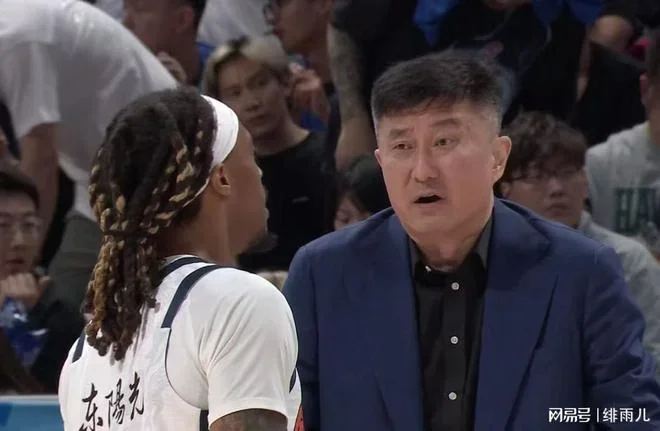
The highly anticipated Game 3 of the CBA playoff quarterfinals drew widespread attention as the Beijing Shougang team defeated Guangdong at home, securing a 2-1 series victory and advancing to the semifinals against Shanghai. Guangdong’s season came to an abrupt end, with Zhu Fangyu’s significant offseason investments yielding no tangible results. However, head coach Du Feng stated after the game that he has no regrets about the season and will not voluntarily step down during the offseason. This signals that Guangdong is unlikely to undergo a coaching change in the next two to three years.
Given this situation, Du Feng believes the only way to turn things around is through a major roster overhaul. Although Guangdong boasts several national team players—Cui Yongxi, Jiao Boqiao, Hu Mingxuan, Du Runwang, and Xu Jie—the team’s chemistry has failed to materialize. Jiao Boqiao’s departure seems imminent following his conflict with Du Feng, while Cui Yongxi still needs more time to regain his form. Xu Jie and Hu Mingxuan gave everything they had in the playoffs. Among the players, only Hu Mingxuan and Quinn delivered standout performances in the postseason. The rest, including Xu Jie, McCall, Salinger, Zhang Haojia, Du Runwang, and Wang Shaojie, largely fell short of expectations.
Wang Shaojie lacks the physical tools of a Zhou Qi or JaVale McGee, and he was already drained by the series. If his buyout price is reasonable, Guangdong could attempt to secure the former top pick’s permanent rights from the Beijing Royal Fighters. Should the Royal Fighters demand an exorbitant fee, Guangdong might let Wang go. Zhang Haojia and Du Runwang are clearly ill-suited for Guangdong’s fast-paced system; their lack of mobility cannot be compensated for by effort alone. New import Lacevic struggled both offensively and defensively, getting blocked by Zeng Fanbo and dominated at the other end.
Unsurprisingly, Guangdong could see up to six players leave during the offseason. Zhang Haojia and Du Runwang might be packaged in a trade for players like Zou Yang of Fujian or Zhu Mingzhen of Nanjing Tongxi. Even if no immediate impact players are acquired, Guangdong could target younger prospects like Yuan Zhuoyao of Guangzhou. Imports Salinger, McCall, and Lacevic are unlikely to stay, as all failed to reach the top-tier level in the CBA. Thus, Guangdong may clean house by releasing Jiao Boqiao, Zhang Haojia, Du Runwang, Lacevic, Salinger, and McCall, freeing up roster spots to develop youngsters like Chen Jiazheng and Wang Hongze, and signing stronger import combinations.
In summary, if Guangdong hopes to contend for the CBA championship again, these six players are almost certainly facing departure. However, Du Feng’s tactical system places high demands on forwards and centers, and without recalling Xu Xin, the team will still struggle to compete with top teams like Beijing, Shanghai, and Guangzhou.
