

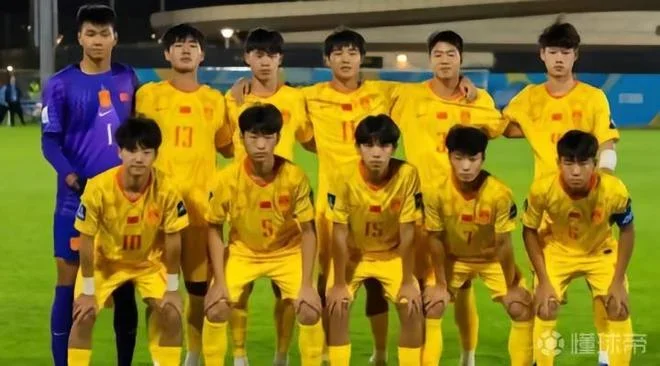
The U17 national youth team’s recent performances at the 2026 AFC U17 Asian Cup have sparked widespread debate. After suffering defeats to Indonesia and Japan in the group stage, the Chinese squad has been heavily scrutinized for its lack of ball control and inaccurate passing. However, according to an analysis by *Oriental Sports Daily*, the root cause lies not with the head coach’s in-game adjustments, but rather with deeper issues embedded in China’s youth development system.
Historically, China was no pushover at the U16/U17 level on the continent. The team twice claimed the Asian title—in 1992 and 2004—showcasing decent physique, competitive spirit, and the ability to go toe-to-toe with Japan, South Korea, and West Asian sides. But since 2006, a steady decline has set in. Between 2016 and 2018, China even failed to qualify for the tournament, becoming completely disconnected from Asia’s elite youth football. Now, the team seems trapped in a cycle of being eliminated as soon as they reach the finals.
This edition of the U17 Asian Cup has been particularly revealing. The loss to Indonesia signaled that the traditional dominance Chinese youth teams once enjoyed has evaporated. Indonesia’s football has made rapid strides—improved physicality, better match tempo, and sharper tactical execution—making the result less of a surprise and more a symptom of shifting Asian football dynamics. The defeat to Japan, meanwhile, highlighted the chasm in technical and tactical maturity. Japan benefits from a well-established youth development structure, where players are exposed to high-quality competition from a young age, honing their ball-handling, passing combinations, and game intelligence. The gap is not merely a single-goal margin on the scoreboard, but a fundamental disparity in football understanding, training quality, and systemic design.
In summary, the struggles of China’s U17 team are multifaceted: a scarcity of high-level competitive matches, uneven coaching standards at the grassroots, and a lack of solid fundamentals. For 17-year-old players to be unable to retain possession or deliver accurate passes is not a reflection of the head coach’s tactical instructions or line-up choices—it is the growing pain of an entire talent development framework that is still trying to find its footing.
