

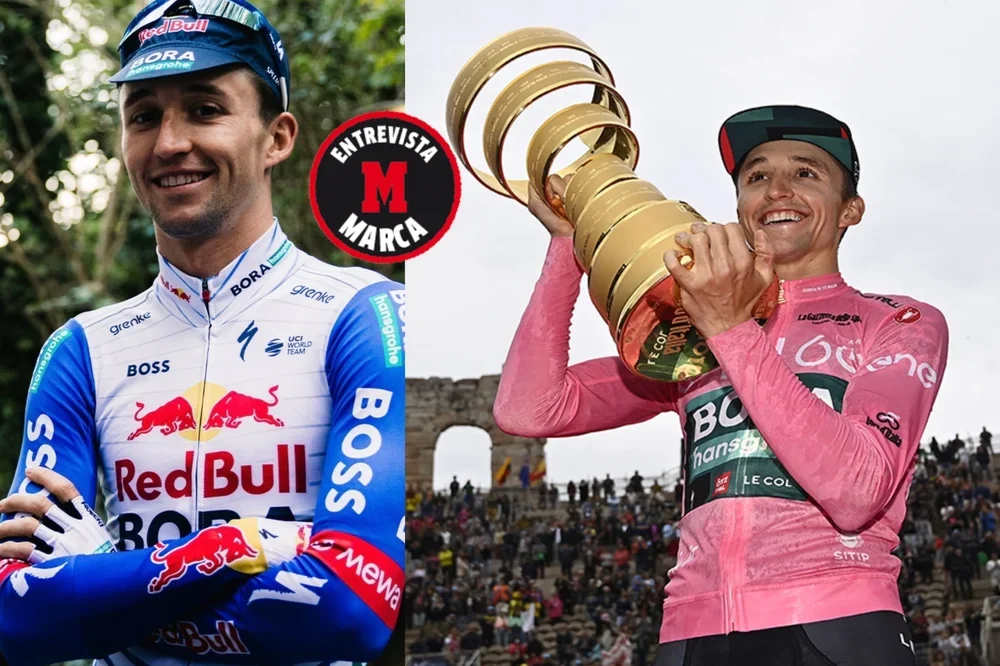
Jai Hindley, ahead of this year’s Giro and with the 2026 Trofeo Senza Fine.
Jai Hindley won the Giro d’Italia in 2022, lifting the Trofeo Senza Fine in Verona. Since then, no one in the peloton has forgotten his name.
This year, he returns to the race that changed his life as co-leader of Red Bull-BORA-hansgrohe alongside Giulio Pellizzari, the team’s great Italian hope.
“It’s always good to come back. It’s my favorite race of the year,” Hindley told MARCA. For him, Italy is more than just a backdrop. “It’s the best place to ride a bike,” he summarizes. He grew up as a cyclist there, learned to live far from home, and found the perfect spot to become someone in the peloton. His partner is also from Italy, working within the Giro’s organization.
Hindley knows better than anyone that this race gives nothing away. Before winning it, he also lost it. In 2020, he came up short, and that wound became a lesson. “After losing the Giro in 2020, I understood that someday I could win it,” he recalls. Two years later, he made it a reality. “I won it by working hard, not by seeking applause,” he adds.
Red Bull is not here for a casual ride. The German structure presents a strong block with a clear objective that Hindley doesn’t hide. “We are here to win it,” he warns. Without grandiosity but with clear ideas: this Giro is serious business. “We are here to get our hands dirty,” he completes, aware that the Italian race rarely comes clean.
Alongside him is Pellizzari, one of Italian cycling’s emerging talents. “Giulio is pure talent,” Hindley says. And he has no problem sharing leadership. “It doesn’t matter who is the captain between Giulio and me.” In the Giro, knowing when to wait is often as valuable as knowing when to attack.
He, whom some rumors place at Visma next season, learned it his way. In 2022, he didn’t win by chance. He endured when he needed to, measured when required, and struck when the race became impossible for others. “The Giro is a 21-day war,” he explains.
That victory changed his life, though he still seems the same calm guy as always. He speaks just enough. He doesn’t seek the spotlight. Now he returns with a different role. He doesn’t carry all the spotlight, but he carries something hard to manufacture: he has won here. And in a race where every day can break in a curve, on a climb, or in a crash thirty kilometers from the finish, that carries a weight that numbers don’t reflect.
Looking ahead, Hindley feels he hasn’t yet reached his ceiling. “My numbers improve every year,” he maintains. And he finishes with a phrase that sounds more like a warning than a wish: “I believe the best is yet to come.”
The Giro has Hindley again. And there is something interesting about that: a rider so understated returns each year to the most dramatic race on the calendar and still looks exactly the same as before. As if it all boils down to one simple idea: “Never give up.”
